
If you’re shopping for jeans, start with the numbers the seller gives you. For a body size chart, measure around your waist and hips. For a listing that gives the dimensions of the jeans themselves, measure a pair you already like and compare the two pairs. This second method is especially handy for buying secondhand, where the jeans may have been worn in or hemmed.
Table of Contents
What does 30 × 32 mean on jeans?
On jeans sized by waist and length in inches, 30 × 32 (also written W30 L32) means waist size 30 and a listed 32-inch inseam. The inseam is the length along the inside of the leg from the crotch seam to the bottom of the hem. Use the waist number as a size label. The actual waistband measurement can differ, and two pairs with the same label can fit differently through the hips and thighs.
Men’s and women’s ranges can use the same waist numbers for different proportions. Some women’s ranges also use numbered clothing sizes such as US 10 or UK 12. If you’re switching ranges or shopping on a different country’s site, use the chart for the item you’re buying. For instance, Levi’s US men’s bottoms chart pairs size 30 with a 30.5–31-inch body waist and a 36.5–37-inch seat. Its US women’s bottoms chart pairs jean size 30 with a 31.25-inch body waist and 40-inch hips. Levi’s US size guide
What does 30R mean, and how long are S, R and L?
When a retailer combines a waist size with a length letter, 30R means waist size 30 in the regular length. S means short, R means regular and L means long in that system. In New Look’s UK men’s jeans chart, 30S, 30R and 30L have listed leg lengths of 30, 32 and 34 inches, respectively. So 30R corresponds to 30 × 32 on that chart. New Look’s UK men’s jeans size chart
Regular is specific to the range and sometimes to the style. For example, Ariat’s UK guide lists a 33-inch regular inseam for its women’s jeans, while Gap’s US listing for its 1969 mid-weight boyfriend jeans specifies a 28-inch regular inseam. Look for the actual inseam under the item’s size or fit details, especially for ankle-length and cropped styles. Ariat’s UK jeans measuring guide · Gap’s US product measurements
How to measure your waist and hips for a size chart
Use a flexible tape measure over underwear or thin, close-fitting clothes. Stand relaxed and keep the tape level and close to your body without pulling it tight. A mirror helps you see if the tape dips at the back. Take each measurement twice and write it down in the units the chart uses. Measure again before shopping if your usual pair has started to fit differently.
For your natural waist, bend gently to one side to find the crease between your ribs and hips, then stand upright and measure around that level. Breathe normally. If the chart asks for a low waist or for the spot where you want the jeans to sit, measure there as directed. For example, low-rise jeans sit lower on the torso, so their waistband may sit below the place you measured for a natural-waist chart. Ariat’s UK jeans measuring guide · Nordstrom’s jeans measuring guide
How to measure your hips or seat
Stand with your feet together and wrap the tape around the fullest part of your hips and buttocks. The number where the tape meets itself is your full hip measurement, sometimes called the seat. Use a mirror or ask someone to check that the tape is level. For example, if your waist is 32 inches and your hips are 41 inches, enter 32 for waist and 41 for hips. Levi’s US size guide
Check both body measurements before choosing a size. For a listing with garment dimensions, measure across the jeans at the hips . A 32-inch body waist can point to different sizes depending on the range. In Levi’s US men’s bottoms chart, for example, 32 inches falls at the upper end of the body-waist range for size 31. If your hips and waist point to different sizes, see which cut gives you room to sit and move while keeping the waistband comfortably in place. Levi’s US size guide
How to measure a pair of jeans laid flat
Choose a pair whose fit you want to repeat. A well-worn pair is a good reference for how you like your jeans to feel, though it may have stretched with wear or changed after washing. Note whether you measured just after washing or after several wears, especially if the waistband tends to loosen. Button and zip the jeans, lay them on a table and smooth the fabric without stretching it. Use the seller’s measuring method whenever it’s given so you compare the same points. Ariat’s UK jeans measuring guide · Blue Owl’s garment measuring guide
Waistband. Line up the front and back of the waistband and measure straight across the top, edge to edge. A flat width of 16 inches gives an approximate 32-inch waistband when doubled. For a listing that gives the flat width, use 16 inches directly.

How to measure the hips on jeans
Measure horizontally across the jeans at the point the seller specifies. The base of the fly can serve as a reference if both pairs are measured there, but fly length varies with the cut. Some guides measure a set distance below the waistband. If you’re asking a secondhand seller for a hip width, agree on where to place the tape. A 20-inch flat hip width gives an approximate 40-inch garment circumference. Atlantic Standard’s measuring guide

How to measure the thigh and rise
Thigh. Measure across one leg near the crotch, at a right angle to the leg. Use the seller’s starting point. Blue Owl, for example, starts at the crotch seam. As with the waist and hips, double the width only for a comparison with a full garment circumference. If you want to know how freely the jeans will fit over boots, measure across the leg opening at the hem as well. Blue Owl’s garment measuring guide

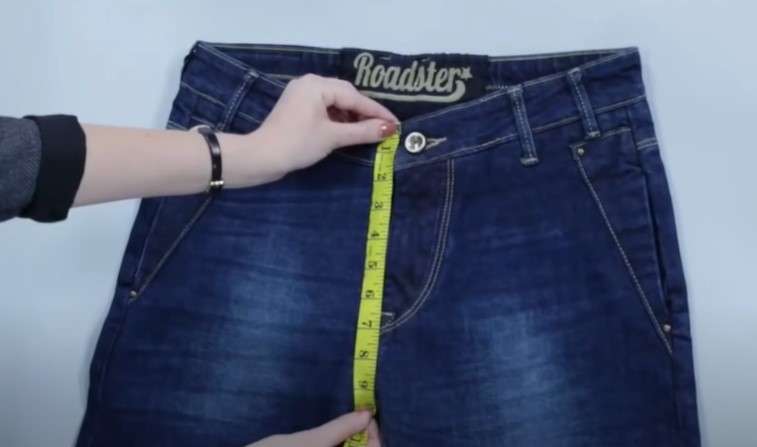
Front and back rise. Measure from the point where the leg seams meet at the crotch to the top of the front waistband, following the center front along the fly. Turn the jeans over and measure from that same crotch point up the center back seam to the top of the waistband. These measurements help explain where the waist sits and how much coverage the jeans give when you sit down. Atlantic Standard’s measuring guide
How to measure your inseam and choose a length
Straighten one leg of the jeans and run the tape along the inside seam from the crotch seam junction to the bottom edge of the hem. That single length is the inseam. Check both legs if you’re measuring for alterations or the hems look uneven. The outseam runs from the top of the waistband to the hem along the outside of the leg. Two pairs can have the same inseam and different overall lengths because of where the waistband sits. Blue Owl’s garment measuring guide

If you don’t have a pair with the right length, wear close-fitting pants and the shoes you plan to wear with the jeans. Stand upright while someone measures down the inside of your leg from the crotch to where you want the hem. Use that as a starting point. A pair with a low-hanging crotch may reach farther down your leg than a pair with the same inseam that sits close to the body.
Choose the hem position with the cut and the shoes together. An ankle-length straight leg can finish just above a low sneaker for a clear gap. A full-length straight leg can touch the top of the shoe with a small fold, called a break. A bootcut can fall over the boot shaft, with enough clearance at the back that it stays off the ground. A longer hem that works with heels might drag with flats. People of the same height can have different leg lengths, so the hem you want is a better guide than a height range or an average inseam. Ariat’s UK jeans measuring guide
How to choose between sizes and cuts
Check where you need room before changing the waist size. Skinny jeans sit close through the leg and have a narrow opening. Slim jeans also fit close, with a little more room. Straight describes the line of the leg, especially from knee to hem, and can come with a closer or roomier thigh. Bootcut widens below the knee. Relaxed cuts give extra room through the seat and thigh, and a boyfriend cut can give a similarly easy fit up top while narrowing toward the ankle. If your usual straight jeans pinch at the thigh but fit at the waist, compare the thigh width on a relaxed straight pair before going up a waist size. Levi’s US fit guide · Gap’s US boyfriend jean fit details
If you’re between sizes, try both in the same cut and fabric if you can. Sit, walk and bend. A waistband should hold the jeans where you want them without digging in when you sit. Stretch denim may give where a rigid pair of the same dimensions feels restrictive. If the smaller pair pulls across the hips or thighs and the larger one only gaps a little at the waist, try a cut with more room through the seat relative to the waist, or consider taking in the larger pair. If both sizes are comfortable, let the amount of room you want guide the choice. Levi’s US fit guide
When hemming or a waist adjustment makes sense
If the waistband, seat and rise feel right and the legs are too long, bring the shoes you intend to wear when you have the hem pinned. On a bootcut, shortening the leg can remove part of the flare. On a tapered leg, which narrows toward the ankle, it can leave a wider opening. If you want to keep a worn-looking hem or another original detail, ask what can be preserved. Lengthening depends on how much fabric is folded inside the hem, and releasing it may show a crease or fade line. A tailor can often take in a small waist gap. A larger adjustment may affect how the back pockets and seat sit. Levi’s US Tailor Shop hem and waist services · North Shore Alterations’ jeans hemming guide
Check for shrinkage before you set the final hem. For jeans you plan to keep and launder, follow the care label and check the length again after washing and drying them as you normally would within those directions. Levi’s says most of its jeans are preshrunk and should change little when cared for as directed. Its Shrink-to-Fit jeans are an exception. They are made to shrink, and Levi’s gives different sizing advice depending on how you plan to wash and dry them. Use the instructions for the specific pair before buying or hemming. Levi’s US shrinkage and Shrink-to-Fit guide